I'm surprised it's taken this long, but digital revenue from music has finally overtaken traditional CD sales for the first time (UK)
Of even more significance is revenue from music subscription services such as Spotify were higher than CD sales alone - highlighting the steep decline in our preference for physical media and the need for the continued embrace of differing licensing models required to support these types of services, something with caused the withdrawal of innovative music streaming and preference service Pandora from the UK market in 2008.
more here : BPI
Showing posts with label Online Markets. Show all posts
Showing posts with label Online Markets. Show all posts


Tuesday
Earth Quakes VS Kittens
Interesting insights from Bit.ly - the URL shortening company.
The question : Do links posted on Facebook last longer than they do on twitter?
To do this Bit.y performed analysis of over 1,000 URL links to determine their half life - " the amount of time at which this link will receive half of the clicks it will ever receive after it’s reached its peak " - in effect, it's shelf life.
The analysis encompassed the following Online channels - Facebook, Twitter, YouTube and Email/Instant messenger. They showed that linked published via YouTube had almost double the "shelf life" than via other channels, with Facebook/Twitter and Email all having similar dynamics for published links.
 Initially I assumed this was due to the time on site for users being higher for YouTube VS Facebook, with this increased time on site translating to links posted on the site being "live" for longer. However a quick check on Alexa showed this not to be the case.

Is this down to engagement levels on the sites, with YouTube having a more lean back audience and therefore more open to the suggestion of a click through or engagement opportunity, or due to Facebook with it's more immediate interactivity and higher volumes of change resulting in links becoming redundant faster?
Disasters VS Kittens
Certain content types showed high initial click-through volume with steep 'tail off' - news articles.
Other content types while having lower volumes, had a longer 'shelf life' with clicks being registered over a longer time period - Kitten's and furry animals. Regardless of the channel where they were posted.
In summary
Content type rather than channel seems to determine the lifespan of the link
Content types that have an immediacy and a relevance that is dependent on time, decay faster than those which could be deemed as 'general'
That YouTube offers and interesting challenge to the channel question, why should YouTube keep links 'live' for twice as long as the other, higher time on site / higer engagement channels.
original post here : link
The question : Do links posted on Facebook last longer than they do on twitter?
To do this Bit.y performed analysis of over 1,000 URL links to determine their half life - " the amount of time at which this link will receive half of the clicks it will ever receive after it’s reached its peak " - in effect, it's shelf life.
The analysis encompassed the following Online channels - Facebook, Twitter, YouTube and Email/Instant messenger. They showed that linked published via YouTube had almost double the "shelf life" than via other channels, with Facebook/Twitter and Email all having similar dynamics for published links.
Is this down to engagement levels on the sites, with YouTube having a more lean back audience and therefore more open to the suggestion of a click through or engagement opportunity, or due to Facebook with it's more immediate interactivity and higher volumes of change resulting in links becoming redundant faster?
Disasters VS Kittens
Certain content types showed high initial click-through volume with steep 'tail off' - news articles.
Other content types while having lower volumes, had a longer 'shelf life' with clicks being registered over a longer time period - Kitten's and furry animals. Regardless of the channel where they were posted.
In summary
Content type rather than channel seems to determine the lifespan of the link
Content types that have an immediacy and a relevance that is dependent on time, decay faster than those which could be deemed as 'general'
That YouTube offers and interesting challenge to the channel question, why should YouTube keep links 'live' for twice as long as the other, higher time on site / higer engagement channels.
original post here : link
Friday
Prodcast
 Timing is everything, especially when deciding when to purchase a product or service. Currently today there are many price comparison sites that will offer to find you the best 'deal' - using techniques to aggregate offers and price information into one place. Other websites show you historical data on product and category price, but wouldn't it be great if you could also understand the best "time" to make the purchase too?
Factors such as product release cycles, seasonality effects, supply / demand volumes and competitive influences all affect the price.
Couple with this the 'loss of use of the product' for the period you are deferring your purchase and you have a complicated array of effects to grapple with in making your decision.
When to buy - products are different
Buying a product differs from say an airline ticket purchase - with a ticket you obtain no benefit from the purchase until the date you fly.
With product you have the dilemma, should I buy now, paying a higher price but gaining the 'benefit' of the product. Will the saving by waiting another two weeks outweigh the benefits and gratification I would otherwise achieve by buying here and now?
Crystal balls
Microsoft have started to tackle this issue by mining large data sets containing sales data, market research information and making use of product "category" trending to forecast price fluctuation and change with a accuracy of over 70%. Using various statistical models and data collection and analysis techniques it offers us a window into a future where we will not only be advised where we can obtain the best deals, but also the all important 'when' to buy.
more here : link
Thursday
The end of the impulse purchase?
Recent research shows not only the pivotal role the Internet now plays in both pre and post purchase cycles as we seek out more value during these recessionary times, but also the key differences between the two largest economies on the planet.
Compared to the US, Asian consumers outranked their counterparts in using digital media when considering purchases:
59% of Asians used the Internet during the pre-purchase journey compared to 28% of consumers in the US;
45% of Asians used a mobile phone during purchase (in-store) compared to 25% of consumers in the US;
19% of Asians used digital media following post-purchase compared to 12% of consumers in the US.
It was also shown 72% of those surveyed had changed their mind about a purchase when they had used their phone in the store.
With the increase in mobile phone usage to access the internet, this spells both an opportunity and a threat to that all but infamous impulse purchase. An opportunity for those retailers and brands who are tuned into their customers key decision considerations and are able to service this real-time, on-demand. A threat for those who continue to blindly use old school tactics in order to influence the consumers purchase decision.
more here : click
Tuesday
Fan on Facebook, what are you worth.......
$136 according to recent research
Trying to place a monetary value on the effectiveness of any advertising is difficult, with social media being no different.
There has been a lot of press recently around the Facebook like button and the effects this has on the peer groups who are part of your online community, but what £ value does being a fan actually mean to brands?
A survey conducted by Syncapse attempts to shed some light onto this areas with some interesting assumptions and findings.
20 top brands analysed
Fans and non fans were compared to measure their previous, current and future behaviours towards these brands.
Being a fan for MacDonald’s – your likely to spend more than $159 more than a non fan.
Fans are nearly 30% more likely to continue being loyal to a brand. Being loyal is not an indication of your spend with that brand, however all of the metrics indicated a higher spend for fans than non fans across all brands.
Brand advocates and WOM
A huge part of social networking is the recommendation network, you telling your peers and friends about your preferences and recommendations. This is the oldest form of advertising, is the basis for viral and is deemed as ‘earned’ media by marketers – see bought owned and earned.
Being far from free ( your initial outlay and marketing to drive brand awareness ) it most certainly is a benefit for any brand to have working for it.
Fan
Facebook fans are 68% more likely to recommend a product or brand, with people more likely to buy if recommended by friend, with this onward recommendation resulting in over a third of these people actually trying the product.
The closeness of the recommender has an impact on this percentage, with family members scoring higher than those with loose social connections. To support this in a previous post I outlined how product types and the advocates peer standing and expert levels effect the onward performance of these recommendations– i.e they are regarded as an expert in the field of music, onwards recommendations have a more likely effect to influence than areas they are not.
It is important to remember that these fan basis exist already without Facebook, however the ability to monitor and articulate ‘numbers’ from the site gives an ability (albeit still open to conjecture) as to what these could be worth.
Full report here : http://www.syncapse.com/media/syncapse-value-of-a-facebook-fan.pdf
When your friends become spammers : http://onehandshake.blogspot.com/2007/02/when-your-friends-become-spammers.html
End of the Sales Funnel
Consumer behaviour when considering a new purchase has often been likened to a funnel - with our initial considerations being broad ( the wide part of the funnel ) to then narrow as we discount brands and products until our final purchase. Marketing positions themselves at each of these decision points, hoping to influence our decisions and behaviours in favour of the brands they represent.
The assumption is once a brand has been discounted, it is no longer part of the evaluation phase - nor would brands who are not part of the evaluation be able to enter further along this funnel.

It's a journey
The funnel was based on the fact traditional marketing revolved around ' pushing ' messages to consumers ( through limited numbers of channels, TV, Print, Outdoor ) at each of these stages. Now consumers ' pull ' content to help assist with the decision making process, as they become more quantified in their need for data to compare and evaluate our options - the rise of price and feature comparison websites, user reviews and recommendation systems pays testimony to this.
Therefore the funnel is more likened to a journey, with brands and products being able to interrupt and join the consideration path at various points as consumers become better informed - in some instances entering at the last minute pushing other products which may have been ' contenders ' all along to the side (although brands in the initial consideration phase are three times more likely to be purchased than brands who are not).
Where to be
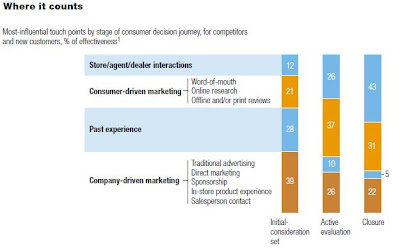 What is evident is it no longer acceptable for brands to focus on a limited number of touch points, the fragmentation of media and virtue in how we evaluate products has changed significantly over the recent years.
With these multiple touch points organisations must ensure that internally they are ' joined up '. Companies need ensure that both the product, marketing, sales and insight data are all leveraged to ensure consistency, quality and relevance of information and product - allowing consumers to 'take' relevant information to reach decisions for themselves.
source: mckinsey the consumer journey
The assumption is once a brand has been discounted, it is no longer part of the evaluation phase - nor would brands who are not part of the evaluation be able to enter further along this funnel.

It's a journey
The funnel was based on the fact traditional marketing revolved around ' pushing ' messages to consumers ( through limited numbers of channels, TV, Print, Outdoor ) at each of these stages. Now consumers ' pull ' content to help assist with the decision making process, as they become more quantified in their need for data to compare and evaluate our options - the rise of price and feature comparison websites, user reviews and recommendation systems pays testimony to this.
Therefore the funnel is more likened to a journey, with brands and products being able to interrupt and join the consideration path at various points as consumers become better informed - in some instances entering at the last minute pushing other products which may have been ' contenders ' all along to the side (although brands in the initial consideration phase are three times more likely to be purchased than brands who are not).
Where to be
 What is evident is it no longer acceptable for brands to focus on a limited number of touch points, the fragmentation of media and virtue in how we evaluate products has changed significantly over the recent years.
With these multiple touch points organisations must ensure that internally they are ' joined up '. Companies need ensure that both the product, marketing, sales and insight data are all leveraged to ensure consistency, quality and relevance of information and product - allowing consumers to 'take' relevant information to reach decisions for themselves.
source: mckinsey the consumer journey
Saturday
Kangaroo "caught"

"heavy heavy heavy"
The Video On Demand service which envisioned the three main UK terrestrial broadcasters serving content through a shared portal was blocked in 2009 by the competition commission; for fear of this collection of content producers monopolising the sector and therefore becoming too powerful.
The £5m campaign has been created by Fallon, which is famous for making the Cadbury Gorilla ad.
Update: Advertising inventory on the platform has now sold out until May without the need for discounting. Is this a simple case of brands wanting to ride the wave of promotion and buzz around the project or a precedence for the future of VOD.
marketing technology

Costing an estimated £25 million in staffing, development and programme rights signified this was no token effort in the VOD space.
Swings and roundabouts
Now it has resurfaced under the banner of "SeeSaw" boasting over 3,000 hours of online content from the BBC, Channel 4 and FIVE.
Currently the service is free, supported by advertising - with paid content due to be launched on the site by the middle of the year.
The future
On the horizon we have BSkyB's entrance into this space and the launch of project Canvas which will deliver content from multiple providers and sources through set-top boxes.
So an ever increasingly crowded space can only mean ever more fragmented choice and confusion for consumers - with a limited library of quality programming.
*Viewing figures online are still tiny when compared to TV - even more so when you consider the number of abandons ( i.e consumers not watching the entire programme ) is significantly higher in the online space.
marketing
Just how SeeSaw expects to derive enough revenue is going to be interesting - consider all the other players are both content producers and have elements of success in the traditional broadcast, therefore splitting their risk with dual revenue streams. SeeSaw will rely 100% on online revenue generation - something the likes of YouTube and Hulu have been grappling with for a long time.
marketing
**Launch
technology
It is promoting its full launch with an ad campaign on Channel 4, Five and ITV – (with which it is yet to secure a deal to show content.)
The £5m campaign has been created by Fallon, which is famous for making the Cadbury Gorilla ad.
Update: Advertising inventory on the platform has now sold out until May without the need for discounting. Is this a simple case of brands wanting to ride the wave of promotion and buzz around the project or a precedence for the future of VOD.
marketing technology
*iPlayer viewing figures
The top five BBC iPlayer shows in January 2010 were:
1. Top Gear Series 14, Episode 7 - 1,135,000 requests
2. Doctor Who: The End of Time Part 2 - 831,000 requests
3. Gavin and Stacey Series 3 Episode 6 - 700,000 requests
4. Mock the Week Series 8 Episode 1 - 658,000 requests
5. Tracy Beaker Returns Episode 1 - 565,000 requests
The figures show TV on the iPlayer was most popular between 8pm and 10pm in January – similar hours to TV peak time – while noon is the time most people listen to radio on the iPlayer.
marketing technology
*source : guardian.co.uk
** source : NMA
Monday
AD:Tech - Meerkats and Search
 over 570,000 meerkat fans
Recent trip to AD:Tech in the UK and some interesting insights from the search providers and HitWise, the analytics company
search
They all focused on online retailers and the challenges they face in attracting and customers making comparisons to there high street cousins and the economic downturn which affecting them both.
With the three ( soon to be 2 ? ) search engine companies going through constant evolution in order to make their offer and effectiveness of their product both better for users and advertisers through improved search results, is this having a direct impact on the paid search market?
marketing technology
All three search providers are investing time and effort of surfacing relevant information in the main search results. In the context of retail this would be location maps, product images and key information which may be buried in the site such as customer service or booking numbers .
This enriched user experience is not only for the benefit of us, Yahoo quoted as seeing as much as a 50% increase in Click through Rates and an increase of 20% in conversion using these methods.
As if to confirm this recent data from Hitwise did indeed points to a decrease in paid search across all online retailer categories with more time and effort going into SEO.
Free lunch
Consumers are now more than ever attracted to offers such as discount vouchers with the success of traditional retailers such as Pizza Express and Threshers (wine retail outline) in the UK using this method. With it’s high viral pass on rates between friends these two companies regularly make use of this tactic, in fact many price comparison sites have built a business model around this aggregating and subsequently redirecting searches from users to these offer however it was noted that many retailers are now looking to capture these users directly through smarter use of SEO rather than having to pay this referral fee to such sites.
Social network - What part do Twitter and Facebook play?
Face book this month announced they were finally cash flow positive along with recording there 300 millionth member , validating there dominant position in the social media space.
Twitters exponential growth is well documented, as is their current inability also to turn a buck.
What is interesting though about both of these players is where do users go after they have visited these sites?
- 1 in 3 Google users ends up at a transactional based website after leaving the site – implying that there is specific intention in the search and therefore the subsequent purchase action.
- Twitter users however have a very different exit, over 55% of its users end up at entertainment sites.
- Social sites users in generally do not end up at online retailers after they have exited the site, with 7% of their traffic finding its way to these.
So social media websites do not work for retailers?
The trend buckers
marketing technology
ASOS the exclusively online retailer of fashion goods and clothing has a quite astonishing funnel of users from social sites – with 14% of it’s traffic coming from Facebook alone ( Google comes in at 25% - which while significantly more is actually less than the usual traffic volume of between 30 – 40% from the site to online retailers) demonstrating the importance of Face-book to ASOS.
marketing technology
Other brands which have managed to setup successful communities in the social space are comparethemarket.com, with their meerkat now having over ½ million Facebook friends and 28,000 followers on Twitter – applying the rationale these users will subsequently visit entertainment site ‘s could be of intrinsically beneficial to a price comparison website if leverage correctly with context of the user being reasonably inferred
marketing technology
Christmas rush online
What was also interesting was online retailers busiest times in the all important build up to Christmas compared to retail outlets.
Online November and first week of December, with then a sharp decline with the opposite in retail outlets taking place.
Reasons cited were as simple as delivery / lead times affecting the level of trust consumers had in online to deliver in time for the holiday season.
Sharp rises in online activity after the Xmas period though may not translate directly to increased in online sales, rather consumers searching for discounts and the location of retail ‘ discount sales ‘.
Online and Retail
marketing
Retailers who offer both an online and retail combination could though seize on the surges and declines – with click and collect offering the convenience of online and security of being able to obtain the goods by going to the store.
Tuesday
The long tail, or "long" nose?
 "nose" or "tail" ?
It's been around four years since Chris Anderson highlighted the opportunities and changes in the market place by being online vs regular store space. His rationale was quiet simple, in a store you are limited by the space you occupy and therefore limited in the choice of tangible products you can sell, online those restrictions do not exist.
Demonstrating this through the now infamous " Long Tail " graph showing the tail as being the area of opportunity (albeit lower volumes) for online distribution channels through 'infinite choice' to the consumer.
By offering these huge online catalogues to consumers, this increased choice would lead them to purchase items which historically would not have been available through regular retail outlets, outlets that must concentrate on the most popular items to maximise there revenues.
Proof in the pudding?
So four years on, the online 'digital media retail' space firmly up and running is this actually the case?
A recent study of tens of millions of online music transactions demonstrated the tail as being not the place of infinite opportunity, but rather a desert island disc (with the focus being on ' desert ').
Apparently the head of the graph represented and area of opportunity which led itself to being more in line with traditional retail space than the new online outlets - so by having this infinite choice available online, consumers were still only purchasing tracks which were readily available in regular music stores.
Myth
So the long tail is just a myth, to be recorded in history as yet further evidence that traditional business models are required to be successful online?
I'm not so sure.
The study itself does not go into any depth as to the geographical nature of the study nor the identity of the online retailer - two key elements which would help understand the audience involved.marketing technology offers oppotunity.
In addition to this I can't ignore the huge success of many online music stores,the fact performing a simple search and being presented with huge back catalogue of choice and recommendations against these - surely with the level of detail the online retailers have into customer behaviour they would not be providing this 'out of the goodness of their hearts'.
marketing technology and it's use does offer new sales channels and routes to markets traditional retail cannot.
What this does prove though is there are more factors and considerations involved than simply putting all your back catalouge online and waiting for the sales to role in.....
Friday
First more channels, now more viewing options

In the past two weeks some important announcements for the future of broadcast - first the move by UEFA to stream and make available via video on demand the up and coming Euro 2008 tournament. Second, the BBC will be streaming live it's flag ship channel BBC 1 via it's website ( only available to those with a TV license - this opens up a very interesting debate ).
The UEFA decision is particularly interesting for a number of reasons.
It is confirmation that the technology is now regarded as ' robust ' enough to charge directly for access to such a prestigious event - there are not many events now that draw such viewing audiences
marketing
Then it also throws open the whole broadcast delivery model, as historically they have given rights and therefore the ability to broadcast these games through partners such as the BBC and Setana
marketing technology
With content now being delivered directly to the consumer it continues to erode the value and position these organisations represent for events such as these. How can traditional broadcasters compete or add value?
Subscribe to:
Posts (Atom)

